
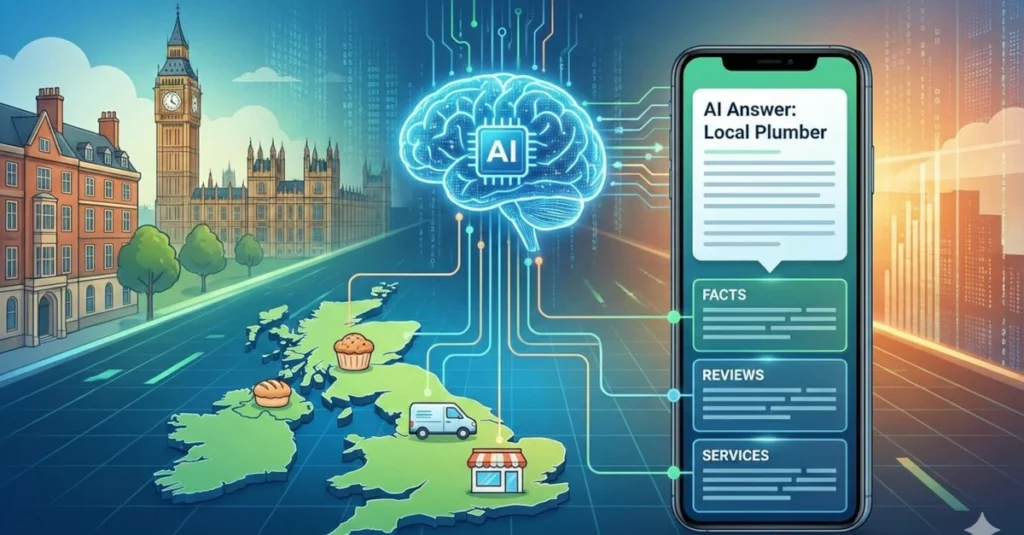
What is Generative Engine Optimization (GEO)?
GEO is the practice of adapting online content to be discovered and used by AI tools like Google’s AI Overviews and ChatGPT. Unlike traditional SEO, which aims to rank web links, GEO aims to provide the facts and data that AI engines use to generate direct answers for users. For businesses, success in GEO relies on building verifiable local trust (reviews), publishing clear, factual information, and formatting content in simple, direct blocks that machines can easily understand and credit.
If you own a website you probably know a little bit about “SEO” (Search Engine Optimisation). For the last twenty years, the goal was simple: get your website to appear at the top of the list when someone typed a service into Google or Yahoo, like “plumber in North London” or “best cupcakes in Brighton.” You wanted to be the number one link so people would click on your site (because people rarely go below position 5 or 6 on the page).
In 2026, the search results game has changed completely.
Now, when people have a question, they don’t just get a list of website links. They get a complete answer written by an Artificial Intelligence (AI) bot, right at the top of the screen, above the website links. They might ask their phone, their smart speaker, or a chatbot like ChatGPT.
If the AI provides the perfect answer instantly, the user doesn’t need to click on a website link at all.
This shift means the old rules of SEO don’t work like they used to. We have entered the era of GEO: Generative Engine Optimisation.
This article explains what that means and exactly what a business needs to do to stay visible in search engines.
1. Why does GEO matter?
To understand GEO, you first need to understand what the search engines are doing differently.
In the past, Google was like a librarian. You asked for a book on a topic, and it gave you a list of ten books to go read yourself.
Today, the AI search engine is like a smart research assistant. You ask a question, and the assistant reads the ten books for you, summarizes the information into a single, clear paragraph, and tells you the answer directly.
Generative Engine Optimization (GEO) is the process of making sure your business provides the information the research assistant uses to write that summary.
If your website is confusing, full of marketing waffle, or hard for a computer to read, the AI will ignore it. If the AI ignores it, you won’t appear in the answer given to the customer. You become invisible to the modern searcher.
For a business, this visibility is vital. If someone asks, “Who is the most reliable electrician in Bristol?” and the AI suggests your competitor because their data was clearer, you have lost that customer without even knowing they were looking.
The goal of GEO is not just to rank; it is to be the trusted source of information that the AI quotes.
2. Thinking like a Machine
The hardest part of GEO is realizing that you aren’t writing for humans first. You are writing for a machine that will then translate your information for humans.
AI models are incredibly smart in some ways, but very literal in others. They don’t like ambiguity, sarcasm, or flowery sales language. They want facts, clarity, and proof.
To succeed in GEO, you need to understand two main concepts: Entities and Trust Signals.
a. Entities (like a digital name tag)
AI doesn’t look at keywords the way old search engines did. It looks for “Entities.” An entity is just a known thing—a person, a place, a business, or a concept.
Google’s AI needs to know for a fact that your business is a real “Entity” located physically in the UK, providing specific services.
If your website says, “We are the best local solutions provider for piping issues,” a human knows you are a plumber. A machine, however, might get confused. It prefers you to say, “Smith & Sons is a plumbing business located in Manchester, UK, specializing in emergency pipe repairs.”
GEO is about making sure your digital name tag is perfectly clear.
b. Trust Signals (proving you are real)
Because AI can sometimes make things up (called “hallucinations”), the search companies are obsessed with accuracy. They only want their AI to use information from sources they trust.
How does a machine know it can trust a small bakery in Cardiff?
It looks at what others say about you. It looks at your Google Business Profile reviews. It checks if you are listed in reputable UK directories (like Yell or Thomson Local). It checks if local newspapers or other local businesses have mentioned you on their websites.
If you say you are the best, the AI is skeptical. If 500 local customers say you are the best in their reviews, the AI trusts that data.
3. Your GEO Action Plan
So, what should a business actually do right now? You don’t need to learn complex coding. You just need to change how you present information online.
Here is a four-step plan for adapting to GEO:
Step 1: Master Your Local Presence (the foundation of trust)
Before you touch your website, you must ensure your external reputation is solid. This is the most critical “trust signal” for local businesses.
Google Business Profile (formerly Google My Business):
This must be perfect. Ensure your business name, UK address, phone number, and opening hours are exact (learn more about NAP). List every specific service you offer.
Reviews are Fuel for AI:
AI models love reviews. They read them to understand what your business is actually like. You need a steady stream of recent reviews. Don’t just ask for “a review”; ask customers to mention what they bought. A review saying “Great service fixing my boiler yesterday” is worth ten times more to an AI than a review that just says “Good.”
Respond to Everything:
When you reply to reviews (both good and bad), you show the AI that the business is active and cared for.
Step 2: Write “Answer Capsules” on your website
This is the biggest practical change in writing for the web. You need to provide direct answers to the questions your customers ask.
Instead of writing long, winding paragraphs about your history, create sections on your service pages that look like the “Answer Capsule” at the start of this article.
The Formula: Ask a specific question in a heading. Immediately follow it with a 50 to 70-word direct, factual answer. Do not use sales language.
Example for a UK Accountant:
Heading: Do small businesses in the UK need to register for VAT?
Answer Capsule: In the UK, a business must register for VAT with HMRC if its VAT-taxable turnover goes over £90,000 in a 12-month period. Businesses with a lower turnover can choose to register voluntarily. Registration is usually done online through the government gateway portal.
By structuring information like this, you are feeding the AI exactly what it needs to construct its summary. You are making its job easy, so it is more likely to use your information.
Step 3: Be the Expert (provide what AI can’t)
AI can summarize existing knowledge perfectly, but it cannot create new knowledge or have real-life experiences.
If you write generic articles that anyone could find on Wikipedia, the AI doesn’t need your website. It already knows that information.
To stand out, you must provide unique value based on your real-world experience. This is often called E-E-A-T (Experience, Expertise, Authoritativeness, and Trustworthiness).
Show, Don’t Just Tell:
Don’t just list your services. Show photos of your team actually doing the work in your local area.
Use Original Data:
A local estate agent shouldn’t just write about “national housing trends.” They should write about “Average 3-bedroom house prices in the B74 postcode area in early 2026.” AI loves unique data that it can’t find anywhere else.
Author Bio:
Make sure it is clear who is writing the content on your site and why they are qualified. “Written by Jane Smith, certified electrician with 15 years of experience in London.”
Step 4: Technical Clarity (helping the crawlers)
Finally, you need to ensure your website isn’t blocking the AI “crawlers” (the bots that read your site) – work with your web developer or website hosting provider to ensure the AI bots can access your website.
You don’t need to be a developer, but you should ensure your website uses a clear structure. Use headings (H1, H2, H3) logically. An H1 is the main topic of the page, H2s are sub-topics, and H3s are specific points under those sub-topics.
This structure acts like a skeleton for your content, helping the AI understand which parts are most important. Work with a knowledgeable web agency to help you with constructing semantic structure for your website.
In conclusion
The transition from traditional SEO to Generative Engine Optimization might seem daunting, but it is actually a move towards simplicity.
The search engines no longer want you to chase algorithmic tricks. They want you to be a legitimate, trusted business that communicates clearly and factually.
For businesses, the recipe for success in 2026 is straightforward:
- maintain a high-quality local reputation (e.g. via Google reviews, Google Business Profile info, local directories etc);
- answer customer questions directly on your website without fluff (using FAQs); and
- prove your real-world expertise (through deep and insightful articles on your website).
If you do this, you won’t just be visible to humans; you will be the recommended choice of the machines they rely on. Contact us to see how we can help you get your website ready for GEO.